
October is Mental Health Awareness Month: How Debt Impacts Your Mind
October is Mental Health Awareness Month in South Africa. Did you know that debt and mental health are deeply connected? Across the country, thousands of people struggle with financial stress and anxiety, which often leads to burnout, depression, and strained relationships. At DCGsa — South Africa’s trusted debt review specialists — we believe financial freedom equals mental freedom. Taking control of debt stress is not only about money, it is also about protecting your peace of mind, your relationships, and your future.
At DCGsa (Debt Counselling Group South Africa), we believe:
👉 Financial freedom = mental freedom.
When your money is under control, so is your peace of mind.
The Hidden Link Between Debt and Mental Health
Debt affects more than just your bank account. In fact, financial stress is one of the leading triggers of mental health challenges in South Africa. Counselling Psychologist Christelle Van Tonder explains in Smart Wealth Magazine:
“Debt can cause significant emotional and psychological stress, which can manifest in anxiety, depression, suicidal ideation, sleep disturbances, physical symptoms, strained relationships, and feelings of shame and guilt.”
How Debt Strains Relationships
Counselling Psychologist Christelle Van Tonder explains in Smart Wealth Magazine:
“Debt can cause significant emotional and psychological stress, which can manifest in anxiety, depression, suicidal ideation, sleep disturbances, physical symptoms, strained relationships, and feelings of shame and guilt.”
When you’re living under the pressure of unpaid bills, creditor calls, or fear of repossession, it doesn’t just stay on paper. It impacts your body, your sleep, your relationships — and your hope for the future.
How Debt Strains Relationships
Money is one of the leading causes of relationship conflict in South Africa. Christelle highlights:
“Couples struggling with debt often avoid discussing financial issues, budgeting together and being transparent about spending habits. This can lead to conflict, trust difficulties and resentment — which ultimately stifles intimacy and emotional connection.”
At DCGsa, we’ve seen how addressing debt together can restore not only financial stability, but also healthier, stronger relationships.
Taking the First Step: From Shame to Strength
Many South Africans feel embarrassed about asking for help with debt. But as Christelle says:
“Debt review is not a sign of failure, but a step towards financial freedom. You’ve taken the first step by acknowledging your situation and seeking help. Stay committed, be patient, and celebrate your progress. You got this!”
Talking about money stress isn’t weakness — it’s courage.

Practical Tips for Protecting Your Mental & Financial Health
DCGsa: Standing With You This Mental Health Awareness Month
This October, we stand with every South African fighting silent battles.
At DCGsa, our mission is to lighten the load by giving you the tools, guidance, and protection to rebuild your financial and emotional well-being.
Want deeper insights from Christelle Van Tonder on mental health and debt?
She shares her expertise in a 2-page feature article in the latest issue of Smart Wealth Magazine.
Frequently Asked Questions about Debt Counselling
Before DCGsa can issue your Form 19 clearance certificate, we must check that the correct documents and confirmations support your clearance.
This is not only an internal DCGsa preference. It forms part of the legal and regulated clearance process.
A clearance certificate confirms that the accounts included in your debt review have been dealt with correctly. For this reason, DCGsa must make sure that the debts that went under debt review match the documents that support clearance.
The documents and confirmations may include paid-up letters, prescribed debt confirmations, written-off confirmations, settlement confirmations, updated balances, account number confirmations, and bond confirmations where applicable.
The most important document is usually the paid-up letter.
A paid-up letter confirms that the credit provider accepts the account as settled.
A PDA statement is also important because it shows the payment history through the Payment Distribution Agency. However, the PDA statement does not replace the paid-up letter from the credit provider.
DCGsa may need to check the following before issuing your Form 19:
The list of accounts that formed part of your debt review.
The PDA payment history.
Paid-up letters from credit providers.
Whether each paid-up letter matches the correct debt review account.
Whether any account number or reference number changed during the process.
Whether an account was handed over, sold, ceded, transferred or moved to a recovery department.
Whether the correct credit provider, collector, attorney or current account holder gave the confirmation.
Whether any end balance difference remains.
Whether any final distribution still needs to take place.
Whether any lawful outstanding aftercare or process-related amount remains.
Whether any bond account is up to date, where applicable.
Whether the file legally qualifies for clearance.
In some cases, the documents are straightforward. The account numbers match, the paid-up letters arrive quickly, and the file can move to the next step.
In other cases, DCGsa may need more time.
This may happen where a credit provider still shows a balance, where a paid-up letter uses a different reference number, where an account moved to a collector or attorney, or where a bond account still needs confirmation.
DCGsa must also make sure that the clearance certificate can be properly supported when submitted through the relevant clearance process used between debt counsellors, the National Credit Regulator, credit bureaus and other relevant systems.
If the documents do not match the accounts correctly, the clearance may be queried, rejected or flagged.
This is why DCGsa cannot issue a Form 19 only because the PDA statement shows a low balance, or because a consumer believes the accounts are finished.
DCGsa must first confirm that the file is ready and properly supported.
If you receive any paid-up letter, settlement confirmation, prescribed debt confirmation, written-off letter, balance confirmation, or account communication directly from a credit provider, please send it to DCGsa as soon as possible.
This may help us verify your file faster.
In simple terms: DCGsa must check the accounts, paid-up letters, final balances, account numbers, PDA history, bond status where applicable, and all supporting documents before issuing your Form 19 clearance certificate. This protects your clearance and helps prevent future disputes.
Yes. A handed-over, sold or ceded account can delay your debt review clearance certificate.
This does not always mean something is wrong with your debt review process.
It usually means DCGsa must do extra verification before the account can be accepted as paid up for Form 19 clearance purposes.
During debt review, a credit provider may hand an account to a collection department, attorney, recovery department or external collector. In some cases, the account may also be sold, ceded or transferred to another party.
When this happens, the account may no longer appear in the same way as it did when your debt review started.
The original credit provider may have one account number.
The collector may use a different reference number.
An attorney may use a legal reference number.
A recovery department may open an internal recovery account.
A sold or ceded account may sit under a different company name.
This can make the clearance stage more complicated.
Before DCGsa can issue your debt review clearance certificate, we must confirm that the paid-up letter, written-off confirmation, prescribed confirmation or settlement confirmation relates to the same account that formed part of your debt review.
We cannot simply accept a letter if we cannot match it properly to the debt review account.
This is important because the Form 19 clearance certificate must be supported by correct account information and proper proof.
When the clearance certificate is prepared, DCGsa must confirm which debts formed part of the debt review and which supporting documents prove that those debts have been dealt with correctly.
If the account reference does not match, or if the wrong party gives confirmation, the clearance submission may be delayed, queried, rejected or flagged.
For example, a consumer may receive a paid-up letter from a collector. However, the original debt review account may still sit under the original credit provider’s name or account number.
In that case, DCGsa may need to confirm that the collector’s reference links to the original account.
Sometimes the original credit provider must confirm the link.
Sometimes the collector, attorney or current account holder must confirm it.
Sometimes both sides must provide information before the account can be verified.
This can take time, especially if the account moved more than once during the debt review process.
DCGsa may also need to request updated balances, allocation history, settlement confirmations, paid-up letters or written confirmations from the correct party.
This protects you.
If DCGsa issues clearance without confirming the correct link, a credit provider, collector, attorney or credit bureau may later dispute the account. This can create unnecessary stress, credit report problems or delays after clearance.
For this reason, a handed-over, sold or ceded account must be checked carefully before DCGsa issues the Form 19.
In simple terms: if an account moved during debt review, DCGsa must make sure the final confirmation belongs to the correct account. This may take longer, but it helps protect your debt review clearance certificate from being queried or rejected.
If a credit provider still shows a balance after you paid through debt review, DCGsa must investigate the account before issuing or finalising your clearance certificate.
This can feel frustrating, especially when you have paid every month through the PDA and your PDA statement shows that the account is paid up or nearly paid up.
However, the PDA statement and the credit provider’s own system may not always show the same final balance.
A PDA statement shows payments that went through the Payment Distribution Agency. It helps DCGsa see what was collected, distributed and allocated through the debt review payment process.
The credit provider also keeps its own account record. That record may include interest, fees, insurance, allocation dates, arrears, legal costs, recovery costs, system adjustments, or other account movements.
For this reason, DCGsa must check the credit provider’s final balance before treating the account as paid up for clearance purposes.
A credit provider may still show a balance for several reasons.
Interest may have continued before the proposal was accepted.
Interest may have continued before the court order was granted.
The credit provider may have allocated payments on different dates.
A payment may have been received late, reversed, short-paid or allocated differently.
Service fees, insurance premiums, legal costs or recovery costs may still appear on the account.
The account may have been handed over, sold, ceded, transferred, or moved to a recovery department.
The credit provider may have changed the account number or internal reference.
The credit provider may also not have updated the balance regularly during the debt review process.
This does not always mean that the consumer did something wrong.
It also does not always mean that the PDA did something wrong or that DCGsa did something wrong.
In many cases, it means that the account needs a final reconciliation before the credit provider can issue a paid-up letter.
DCGsa must then check whether the balance is valid, whether it relates to the correct debt review account, and whether the credit provider can issue a paid-up letter or written confirmation.
If the balance is valid, it may need to be settled before the paid-up letter can be issued.
If the balance appears incorrect, DCGsa may need to query it with the credit provider and request a breakdown, updated balance, allocation history, or confirmation of how the balance arose.
If the account was handed over, sold, ceded or moved to another department, DCGsa may also need to confirm which party can issue the paid-up letter or final settlement confirmation.
This can delay the clearance process because DCGsa cannot certify a clearance certificate while a relevant credit provider still reflects an unresolved balance.
When DCGsa issues a Form 19 clearance certificate, the supporting documents must match the accounts that went under debt review. These documents may include paid-up letters, prescribed confirmations, written-off confirmations or other written proof accepted for that account.
The relevant clearance submission may also be rejected or flagged if the accounts and supporting documents do not meet the required standard.
For this reason, DCGsa cannot ignore a credit provider balance simply because the PDA statement looks settled.
In simple terms: if a credit provider still shows a balance, DCGsa must check whether the balance is valid, whether the account is correctly linked to your debt review, and what must happen before the paid-up letter can be issued. This protects your clearance certificate and helps prevent future disputes.
If surplus money remains after your debt review accounts have been paid, the surplus must be dealt with through the correct process.
This can sometimes happen near the end of debt review.
For example, DCGsa may ask you to continue paying until we confirm that it is safe to stop. If your final accounts are then confirmed as paid up, there may be extra money left after the last distributions, final balances, aftercare amounts and required checks have been completed.
We understand that consumers want to know what happens to this money.
The important point is that DCGsa cannot confirm a refund only because the PDA statement appears to show surplus funds. We must first confirm that the file is ready for clearance and that the money is no longer needed for any final debt review-related purpose.
Before any surplus can be dealt with, DCGsa may need to check:
Whether all required paid-up letters have been received.
Whether every paid-up letter matches the correct debt review account.
Whether any credit provider still reflects a final balance.
Whether any end balance difference remains.
Whether any final PDA distribution still needs to take place.
Whether any lawful outstanding aftercare amount remains.
Whether any bond account is up to date, where applicable.
Whether the Form 19 clearance certificate can be properly prepared and supported.
This is why DCGsa normally advises consumers to keep paying until we confirm the next step in writing.
It is usually safer to deal with surplus funds later than to stop payment too early and then discover that a credit provider still needs a final payment before issuing a paid-up letter.
If a final shortfall appears after you have already stopped paying, your clearance certificate may be delayed. You may then need to raise extra funds before the account can be confirmed as paid up.
However, if surplus funds remain after all the final checks have been completed, those funds can be dealt with through the correct refund or distribution process.
The exact process may depend on where the funds are held, whether the PDA still needs to distribute any amount, whether a credit provider must still confirm a final balance, and whether all clearance requirements have been met.
DCGsa must first make sure that the surplus is genuinely available and not still needed for the clearance process.
If you choose to stop, reduce, pause or change your payment before DCGsa confirms that it is safe, DCGsa will require a signed debit order or payment instruction form. This form records your instruction and confirms that you understand the risks of changing your payment before the file is finalised.
Changing or cancelling your debit order does not cancel debt review. It also does not remove the debt review status from your credit profile.
In simple terms: if there is surplus money after your accounts, final balances, distributions and clearance checks are complete, it can be dealt with through the correct process. But DCGsa must first confirm that the money is not still needed to finalise your clearance certificate.
This is a common question near the end of debt review.
Your PDA statement may show that the remaining balance is less than your normal monthly debt review payment. You may then wonder why DCGsa still asks you to continue with the full payment until we confirm the next step.
The reason is that the PDA statement is not the final legal confirmation that every account has been settled.
A PDA statement shows the payments that went through the Payment Distribution Agency. It helps DCGsa see what was collected, distributed and allocated through the debt review payment system.
However, the PDA statement does not replace the final confirmation from each credit provider.
Before DCGsa can issue your Form 19 clearance certificate, we must complete final checks. These checks may include paid-up letters, final balances, account numbers, end balance differences, final PDA distributions, aftercare amounts, and bond status where applicable.
Even if the PDA statement shows a lower balance, a credit provider may still confirm a different final amount. This can happen because of interest, fees, insurance, payment allocation dates, late payments, short payments, missed payments, reversals, legal costs, or system differences between the PDA and the credit provider.
This is why DCGsa must be careful before reducing or stopping your payment.
If you reduce or stop your payment too early, and a credit provider later confirms that more money is still owing, your clearance certificate may be delayed.
You may then need to pay the shortfall before the credit provider issues the paid-up letter. If you have already used that money elsewhere, the clearance process may take longer.
It is usually easier to deal with surplus funds later than to fix a short-paid account at the end of debt review.
If surplus money remains after all accounts, final balances, distributions and required checks have been completed, the surplus can be dealt with through the correct refund process.
DCGsa will only confirm that you may stop, reduce, change or cancel your debt review payment once we are satisfied that it is safe to do so.
If you still choose to stop, reduce, pause or change your payment before DCGsa confirms that it is safe, DCGsa will require a signed debit order or payment instruction form.
This form records your instruction. It also confirms that you understand the possible risks of late, missed, reduced, paused, short-paid or direct payments.
Changing or cancelling your debit order does not cancel debt review. It also does not remove the debt review status from your credit profile.
In simple terms: even if your PDA statement shows a lower balance than your normal payment, please continue paying until DCGsa confirms the next step in writing. This protects your clearance process and helps us close your file correctly.
An end balance difference happens when the PDA system shows one balance, but the credit provider shows a different final balance.
This can happen near the end of the debt review process, even where the consumer has made regular payments through the PDA.
We understand that this can feel frustrating.
Many consumers ask:
“But I paid every month. Why does the credit provider still show a balance?”
This is a fair question.
A PDA statement is a record of payments distributed through the debt review payment system. It helps DCGsa see what was paid, when it was paid, and which credit providers received payment.
However, the credit provider still keeps its own account record. The credit provider’s system may calculate interest, fees, allocation dates, insurance, arrears, legal charges or settlement figures differently from the PDA system.
Because of this, the PDA balance and the credit provider balance may not always match exactly at the end of the process.
An end balance difference does not always mean someone made a mistake. It also does not usually mean that a new debt suddenly appeared.
In many cases, it is a final reconciliation difference between the PDA payment history and the credit provider’s own account system.
End balance differences may happen because of several reasons.
Interest may have continued before the credit provider accepted the proposal or before the court order was granted.
Payments may have been allocated on different dates by the credit provider.
Some payments may have been received late, short-paid, missed, reversed or not allocated correctly.
Service fees, insurance premiums, legal costs, collection costs or account charges may have remained on the account.
The credit provider may have capitalised arrears from the early part of the process.
The account may have moved to another department, attorney, collector, recovery account or internal reference.
The credit provider may also not have updated the balance every month during the debt review process.
This is why DCGsa must complete a final check before issuing the Form 19 clearance certificate.
DCGsa must confirm whether the balance is correct, whether it must still be paid, whether the credit provider can issue a paid-up letter, or whether more information is needed from the credit provider.
If an end balance difference remains unresolved, the credit provider may refuse to issue a paid-up letter. Without the correct paid-up letter or written confirmation, DCGsa may not be able to certify the clearance certificate properly.
This is not done to delay the consumer. It is done because the clearance certificate must be legally and procedurally correct.
If a small final balance is confirmed, the account may need to be settled before the paid-up letter can be issued.
This is one of the reasons DCGsa advises consumers not to stop paying too early. It is usually easier to deal with surplus funds later than to stop payment too soon and then struggle to settle a final shortfall.
In simple terms: an end balance difference is the final difference between what the PDA system reflects and what the credit provider confirms. DCGsa must resolve this difference before the account can be treated as paid up for clearance purposes.
A paid-up letter is written confirmation from a credit provider that an account has been settled.
DCGsa needs paid-up letters before issuing a Form 19 because the clearance certificate must rely on proper proof from the credit providers.
This is not only a DCGsa internal process. It forms part of the legal and regulated clearance process.
When DCGsa issues a debt review clearance certificate, we must be able to certify that the accounts included in your debt review have been dealt with correctly. This means we must confirm which debts went under debt review and match those debts to the correct supporting documents.
These supporting documents may include paid-up letters, prescribed debt confirmations, written-off confirmations, settlement confirmations, or other written proof accepted for the specific account.
A PDA statement shows that payments went through the debt review payment process. A proof of payment shows that money was paid. However, a paid-up letter confirms that the credit provider accepts the account as paid up.
This is why a paid-up letter is one of the most important documents in the debt review clearance process.
Before DCGsa issues a Form 19, we must check that each paid-up letter relates to the correct account under debt review. We compare the account number, reference number, credit provider name, and sometimes the account history.
In many cases, this is simple. The account number on the paid-up letter matches the account number on the original debt review documents.
However, in other cases, it can take longer.
If an account was handed over for collection, sold, ceded, transferred, moved to an attorney, or moved to a recovery department during the debt review process, it may be more difficult to obtain a paid-up letter.
This can happen for many reasons. A credit provider may use a different department. A collector may use a different reference number. An attorney may use a legal reference. A ceded or sold account may sit with a different company. A credit provider may also need time to trace the original debt review account.
This does not always mean something is wrong.
It simply means DCGsa must verify that the paid-up letter or written confirmation relates to the same account that formed part of the debt review process.
After the clearance certificate has been prepared and certified, the supporting documents must be uploaded and checked on the relevant clearance platform used in the debt review and credit bureau process.
On that system, each credit provider and account must be confirmed correctly. If a clearance certificate or supporting documents do not meet the required standard, the submission may be rejected or flagged.
This is why DCGsa cannot issue clearance based only on a verbal confirmation, a low PDA balance, or a proof of payment.
This careful checking protects you. It helps prevent future disputes where a credit provider, collector, attorney or credit bureau later claims that an account was not properly settled.
DCGsa may need to follow up with the credit provider, collector, attorney or current account holder to confirm the correct account link.
This can delay the clearance process, especially where the account moved more than once or where the credit provider no longer uses the original account number.
For this reason, consumers should send DCGsa any paid-up letters, settlement confirmations, prescribed confirmations, written-off confirmations or account communication they receive directly from credit providers.
In simple terms: DCGsa needs paid-up letters and proper written confirmations because the clearance certificate must be certified and supported by proof. If the account was handed over, sold, ceded or moved during debt review, DCGsa may need extra time to verify the documents before issuing your Form 19 clearance certificate.
A PDA statement is very important, but it is not enough on its own for a debt review clearance certificate.
The PDA statement shows payments that went through the Payment Distribution Agency. It helps DCGsa see what payments were collected, how the funds were distributed, and which credit providers received payments during the debt review process.
However, a PDA statement does not replace a paid-up letter from a credit provider.
A PDA statement may show that an account looks paid up, nearly paid up, or even at a zero balance. However, DCGsa must still confirm that the credit provider accepts the account as settled.
This is why DCGsa needs paid-up letters or final written confirmation from the credit providers before issuing a Form 19 clearance certificate.
A simple way to understand it is this:
The PDA statement shows the payment history.
The paid-up letter confirms the settlement of the account.
These two documents do different things.
The PDA may calculate balances based on the debt review payment plan, payment distributions, proposal information, or available system data. The credit provider’s own system may show a different final balance because of interest, payment allocation dates, fees, insurance, missed payments, short payments, or system updates.
This difference is often called an end balance difference.
An end balance difference does not always mean someone made a mistake. It also does not always mean that a new debt appeared. It normally means DCGsa must reconcile the final position before the credit provider can confirm the account as paid up.
DCGsa also needs to check that the paid-up letter matches the correct debt review account. Sometimes account numbers change when accounts are handed over, moved to legal departments, converted into recovery accounts, or linked to new internal reference numbers.
If DCGsa relies only on the PDA statement and later a credit provider disputes the account, the consumer may experience delays, credit bureau problems, or future balance disputes.
For this reason, DCGsa must use the PDA statement as part of the checking process, but not as the only proof of clearance.
In simple terms: your PDA statement shows that payments were made, but your paid-up letter confirms that the credit provider accepts the account as settled. DCGsa needs both the payment history and the final credit provider confirmation before issuing your debt review clearance certificate.
No. You should not stop paying only because your debt review accounts look paid up, nearly paid up, or low on the PDA statement.
You must continue paying until DCGsa confirms in writing that it is safe to stop, change, reduce or cancel your debt review payment.
This is very important at the end of the debt review process.
A PDA statement is a helpful payment record, but it is not the same as a paid-up letter from a credit provider. The PDA may show that payments have been distributed, or that an account appears to have a low or zero balance. However, DCGsa must still confirm the final position with the credit providers before issuing a Form 19 clearance certificate.
Before DCGsa can confirm that you may stop paying, we must check whether your file legally qualifies for clearance. This may include checking paid-up letters, final balances, account numbers, end balance differences, final PDA distributions, and bond status where applicable.
Sometimes an account looks paid up on the PDA system, but the credit provider still shows a small balance. This may happen because of interest, payment allocation dates, fees, insurance, missed payments, short payments, or system differences between the PDA and the credit provider.
For this reason, stopping too early can delay your clearance certificate.
If you stop paying before DCGsa confirms it is safe, and a credit provider later confirms that a balance remains, you may need to pay the shortfall before the paid-up letter can be issued. If you have already used the money elsewhere, the clearance process may be delayed.
It is usually easier to deal with a refund of surplus funds than to fix a short-paid account at the end of the process.
If you insist on stopping, reducing, pausing or changing your debit order before DCGsa confirms that your file is ready, DCGsa will require a signed debit order or payment instruction form. This form records your instruction and confirms that you understand the possible risks of stopping, reducing, pausing or changing your debt review payment.
Changing or cancelling a debit order does not cancel debt review. It also does not remove the debt review status from your credit profile.
In simple terms: please keep paying until DCGsa confirms the next step in writing. This protects your clearance process and helps us close your file correctly.
A Form 19 is the official debt review clearance certificate that a Debt Counsellor gives to a consumer who qualifies for clearance from debt review.
It confirms that the consumer has completed the required debt review obligations. It also allows the Debt Counsellor to notify the credit bureaus and relevant systems that the debt review process has been completed.
DCGsa can only issue a Form 19 after checking the file properly. We check paid-up letters, final balances, account numbers, end balance differences, and bond status where applicable.
In simple terms, the Form 19 helps start the process of updating your debt review status with the credit bureaus.
Can I Leave Debt Review?
Many people ask us: “What if I change my mind — can I leave debt review?” At DCGsa, we explain it like this: debt review is designed to protect you, not trap you. Once you step in, it works like a lifeboat when you’re caught in a storm.
Why You Can’t Just Get Out of Debt Review
Imagine you’re in a small boat that’s taking on water. You have two choices:
Which choice will get you to shore safely? Debt review is like plugging the holes — it protects your home, car, and family from sinking under debt.
Exiting Debt Review Before a Court Order
If you’ve only just started and your case hasn’t gone to court yet, the court can still look at your situation. If they find you are not actually over-indebted, then debt review will end there. But this is a court decision, not something you can just choose on your own.
Exiting Debt Review After a Court Order
Once the court has approved your repayment plan, you’re fully protected. From here, you can’t just walk away — but that’s a good thing. It means creditors can’t take your car or home while you’re under the plan.
The only safe way out is to finish the plan or pay off the debts early. When you do, you’ll get a clearance certificate that wipes the debt review flag from your name.
Beware of False Promises Regarding Exiting Debt Review
Some companies claim they can “remove you from debt review” for a big fee. The NCR warns these services are fake and often take money without helping at all. DCGsa never charges such fees. The only real way out is by following the law and completing your plan safely.
Key Takeaways
You cannot simply leave debt review, but that’s because it’s built to protect you until you’re safe again. Think of it like staying in the lifeboat — it may take time, but it’s the safest way to reach financial freedom. At DCGsa, with Casper le Grange, you are never alone on this journey.
Latest National Credit Regulator Update on Exiting Debt review


What is Debt Review?
Debt review is a legal process in South Africa, established under the National Credit Act (NCA), and it is specifically designed to assist consumers who are struggling to repay their debts. Through this process, you gain breathing space from relentless creditor pressure, while at the same time ensuring that your assets are protected. At DCGsa, our goal is not only to guide you through each step but also to help you steadily work towards a debt-free future — all under the expert care of our NCR-registered Debt Counsellor, Casper le Grange.
Debt Review Gives You Legal Protection Against Creditors
Once you enter debt review, your creditors cannot take legal action against you for unpaid debts (as long as you make your agreed repayment). All credit provider communication must go through us. This means no more threatening calls or letters, giving you peace of mind from the very beginning.
How Debt Review Works
The process begins when you apply with DCGsa. We:
You pay a single reduced instalment every month through a Payment Distribution Agency (PDA). From there, the funds are securely distributed to all your creditors, and at the same time, you receive a monthly Distribution Statement. This way, you can clearly see how much each credit provider has been paid.
What Debts Are Included under Debt Review?
Debt review covers most credit agreements, including:
It does not cover monthly living expenses (groceries, school fees, insurance, etc.), but by reducing your debt repayments, debt review frees up more money for these essentials that we assist you in budgeting for so you are not left wondering how to get through a month.

Debt Review End Goal: Debt Freedom
Debt review is not permanent. Once your repayment plan is complete, you’ll receive a clearance certificate that confirms all your debts have been paid off (or paid as agreed). At this point, the debt review flag is removed from your credit profile, and you’re free to take on credit again — this time with a clean slate.
Casper le Grange explains it clearly:
“Debt review is not about restricting you; instead, it’s about protecting you. In addition, it helps you rebuild your finances, and ultimately, it gives you back full control of your life.”
Debt review is a legal and structured process that not only protects you from creditors but also reduces your monthly repayments. As a result, it helps you pay off debt in a safe and at the same time affordable way. With DCGsa — and more importantly, with the personal guidance of Casper le Grange — you gain both the expertise and the support you need to finally become debt free.
Error: Contact form not found.

You may also enjoy this -
How Debt Review Actually Works (in Plain English)
How immediate is Debt Relief through Debt Review?
At DCGsa, one of the most common questions we get is: “How quickly will I feel the relief once I enter debt review?” The good news is that the relief begins almost immediately, both emotionally and financially.
Immediate Emotional Relief (Day One)
The moment you apply for debt review with DCGsa, your creditors can no longer harass you with calls, emails, or threats of legal action. We immediately send a formal notification to all your credit providers — which means they must deal directly with us, not you.
This step alone gives most clients a powerful sense of relief and control from day one.
First Financial Relief (First Month)
Once we’ve reviewed your budget and restructured your debts, you’ll make your first reduced repayment through an accredited Payment Distribution Agency (PDA).
For most clients, this new single payment is significantly lower than what they were paying before. That means more money left in your household budget for essentials like groceries, school fees, and transport.
Long-Term Debt Freedom (Commitment & Consistency)
Debt review is not a “quick fix” — it’s a structured, legal process under the National Credit Act (NCA). While emotional relief is immediate, and financial relief begins with your first reduced payment, true debt freedom takes commitment.
As Casper le Grange, our NCR-registered Debt Counsellor with over 15 years of experience, reminds clients:
👉 “Your debt doesn’t disappear overnight, but the first step in debt review gives you breathing space again — and that breathing space is life-changing.”
✅ Key Takeaway
Debt relief with DCGsa is immediate in terms of protection from creditors and emotional peace of mind. Financial relief begins with your first reduced repayment, and long-term debt freedom is achieved by sticking to the plan.
Pay One Affordable Monthly Payment towards ALL Your Debt. No Juggling Payments anymore.
We negotiate for Reduced Debt Repayments. So you pay your reduced payment from your next pay date, giving relief from your next pay date.
Your assets are protected by law. Creditors must stop legal action, including repossession or garnishee orders, as long as you comply with the agreed plan.
Debt Review isn’t just about managing payments—it’s about reclaiming your life.
You will get immediate stress relief once you apply for our services.
Error: Contact form not found.
How Long Does Debt Review Last?
Many South Africans ask, “How long does debt review last?” The answer depends on your unique financial situation. Debt review is designed to give you a structured repayment plan so you can become debt free in a realistic timeframe. On average, most consumers complete the process in 3 to 5 years, but the duration varies depending on debt size, repayment consistency, and interest rates.
Understanding How Long Does Debt Review Last in South Africa?
Debt review does not have a fixed end date for everyone. Your repayment plan is calculated according to your monthly affordability and the agreements made with your credit providers. Some consumers complete the process in as little as two years, while others may take longer than five years if their debt load is higher.
Factors That Affect the Debt Review Timeline
Several factors influence how long debt review lasts for you:
Court Approval of Debt Review Repayment Plan and Term
Once DCGsa has negotiated reduced interest rates, lower monthly repayments, and adjusted fees, the next step is going to court. The court order makes your new repayment plan legally binding, ensuring that credit providers must stick to the agreement. At this stage, you’ll also see the exact term for each debt if you stick to your repayment plan. This gives you a clear timeline and peace of mind about when you’ll finally be debt free.
When Debt Review Ends: The Clearance Certificate
Debt review officially ends when all your debts included in the process are fully repaid. At that point, your debt counsellor issues a clearance certificate. This certificate is then sent to the credit bureaus, and they update your profile to reflect that you are debt free.
How DCGsa Helps You Complete Debt Review Successfully
At DCGsa, we guide you through every step of the journey. Our team ensures your repayment plan is manageable, helps you stay on track with payments, and communicates with credit providers on your behalf. With our support, you can complete the process faster and enjoy the freedom of a fresh financial start.
Contact DCGsa for Expert Guidance – Or find out if you qualify for debt review.
If you’re considering debt review and need professional advice, DCGsa is here to assist you every step of the way.
- Call us: 086 100 1047
- Email us: help@dcgsa.co.za
- WhatsApp us: 061 432 8499
- Watch our videos on YouTube: DCGsa Debt Counselling Group
For more information, on How Debt Counselling Works – CLICK HERE

Confused about choosing between a Consolidation Loan and Debt Review? Let DCGsa help you find the best solution for your financial situation.
Deciding between debt review and a consolidation loan depends on your financial situation, habits and goals. Both options aim to make debt more manageable, but they work differently and serve different purposes. Let’s explore their key differences.
What Is Debt Review?
Debt review restructures your debt repayments through a legal process. A debt counsellor assesses your financial situation, negotiates with creditors, and creates a repayment plan that proposes reduced monthly installments and interest rates. The National Credit Act (NCA) regulates debt review, which legally protects over-indebted consumers.
What Is a Consolidation Loan?
Debt relief options – To consolidate multiple loans, you add up what you owe on all your debts and apply for a new loan to settle them all. This approach simplifies payments by consolidating your debt under one lender however there is still high interest rates, initiation fee, service fees etc. that need to be paid on this loan. Qualifying for a consolidation loan requires a good credit score and proof of affordability. And If you are not diligent to use the funds to pay off your other debt, you put yourself in a worse situation.
Key Differences Between Debt Review and a Consolidation Loan
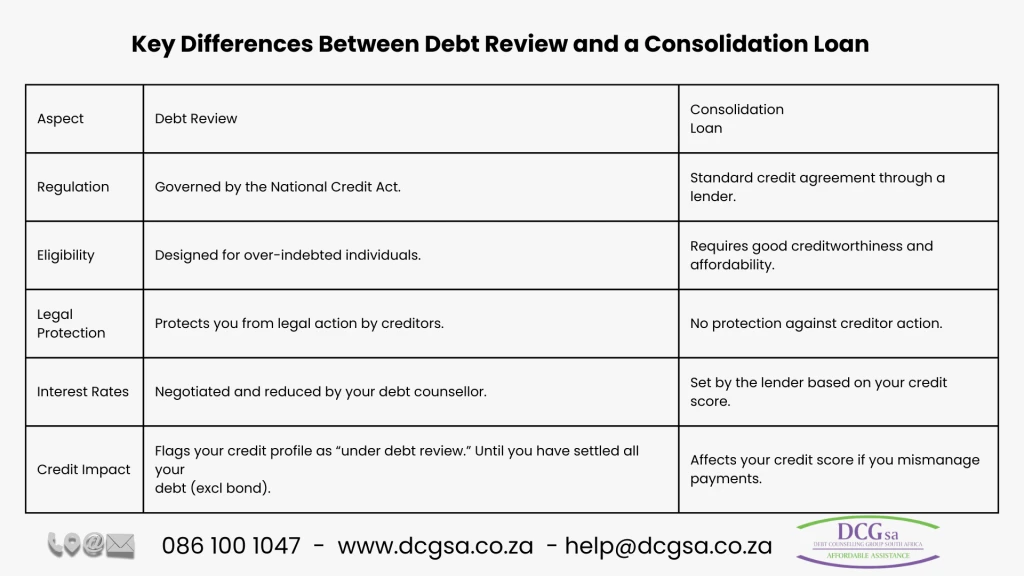
[rev_slider alias="Home_Page" slidertitle="Home Page"][/rev_slider] Confused about Debt Review vs. Consolidation Loans? This quick comparison chart shows the key differences to help you make an informed decision.
When Should You Choose Debt Review?
- Your debt exceeds your ability to repay it.
- Or you Pay your debts and have nothing left for your household needs.
- You need protection from creditors and legal action such as vehicle or home repossession.
- Your credit score is too low and you are rejected for credit due to too much negative profile history.
- You prefer a structured, solution to pay off debt with a professional to guide you.
When Should You Choose a Consolidation Loan?
- Your credit score qualifies you for favorable loan terms.
- You want to simplify multiple debts into one payment.
- You have manageable debt and don’t need additional help.
- You feel confident in managing your finances independently.
Which Option Is Right for You?
Debt review works best for over-indebted individuals who need legal and financial relief. A consolidation loan suits consumers with good credit who want to streamline their debt into one manageable payment.
Contact DCGsa for Expert Guidance
Not sure which option fits your needs? DCGsa provides professional advice to help you make an informed choice about your financial future.
📞 Call us: 086 100 1047
📧 Email us: help@dcgsa.co.za
💬 WhatsApp us: 061 432 8499
▶️ Watch our videos on YouTube: DCGsa Debt Counselling Group
For more details, visit our Debt Counselling Services page.
Can debt review be removed? Understand the legal provisions, including repayment or court orders, required to exit debt review. Contact DCGsa for expert guidance today.
Can Debt Review Be Removed?
No, a consumer cannot voluntarily remove themselves from debt review once the process has been initiated according to the National Credit Act (NCA). Debt review is a legal process designed to assist over-indebted individuals, and its removal is governed by strict legal provisions.
When Can a Consumer Exit Debt Review?
After Full Repayment:
- Once all debts, excluding a home loan, are fully repaid, the debt counsellor may issue a clearance certificate in terms of Section 71 of the NCA. This is the only way to exit debt review after a court order has been granted. Receiving a clearance certificate is like pressing reset on your credit report. It removes any record that you were ever under debt review and removes all adverse credit report information, leaving you with a fresh start.
Before a Magistrate Court Order:
- If the consumer has been determined to be over-indebted but no court order has been granted, they may present new facts to the Magistrate Court. If the court finds the consumer not over-indebted, the debt review process ends, and the credit bureaus are updated accordingly. This will however affect your credit record as it will only remove the debt review flag and not any adverse information such as – missed payments, short payments or any other negative information regarding your credit profile.
When Can’t Debt Review Be Removed?
Voluntary Withdrawal:
- Once a consumer applies for debt review in the prescribed manner (Form 16), they cannot voluntarily withdraw from the process. The Van Vuuren judgment clarified that the NCA does not allow for voluntary withdrawal after application.
After a Magistrate Court Order:
- If a debt re-arrangement order has been granted by the court, the consumer must complete the repayment plan or obtain a clearance certificate to exit debt review.
High Court Orders:
- The Magistrates Court nor The High Court can terminate a debt review process or declare a consumer no longer over-indebted.
What Happens If a Consumer’s Financial Situation Improves?
When a consumer’s financial situation improves during debt review, they should increase their debt review payments or settle debts to shorten the repayment term. Taking these proactive steps helps them exit debt review sooner through a Form 19 Clearance Certificate, achieving financial freedom faster than initially planned.
Contact DCGsa for Expert Guidance
If you’re under debt review and unsure of your options, DCGsa can guide you with professional advice and support tailored to your needs.
📞 Call us: 086 100 1047
📧 Email us: help@dcgsa.co.za
💬 WhatsApp us: 061 432 8499
▶️ Watch our videos on YouTube: DCGsa Debt Counselling Group
Free Credit Check and Debt Assessment – Click Here.
Learn more on this News24 Article that our Debt Counsellor Casper le Grange was quoted in.
Learn how to exit debt review legally and effectively with Form 19. Expert advice from Casper le Grange, featured on News24.
Consumers gain a structured and legally protected pathway to manage and overcome over-indebtedness by engaging with a registered debt counsellor like Casper le Grange (NCRDC1560). The National Credit Act establishes a regulatory framework, and the National Credit Regulator enforces it to ensure debt counsellors maintain high standards of professionalism. This approach gives consumers peace of mind and a practical solution for achieving financial stability.
No, debt review is not the same as administration. While both are legal debt solutions for consumers, they are distinct processes governed by different laws and suited for different financial situations. Debt review falls under the National Credit Act (NCA), while administration is regulated by the Magistrates’ Court Act.
5 Differences Between Debt Review and Administration
- Governing Legislation:
- Debt Review: Regulated by the National Credit Act (NCA).
- Administration: Governed by the Magistrates’ Court Act.
- Debt Limitations:
- Debt Review: No limit to the amount of debt; suitable for individuals with larger debt loads.
- Administration: Only applies to debts below R50,000.
- Assets Protection:
- Debt Review: Protects assets like your home and car from repossession as long as payments are maintained.
- Administration: Offers limited asset protection and may result in asset liquidation in some cases.
- Payment Distribution:
- Debt Review: Payments are managed through a Payment Distribution Agency (PDA), ensuring creditors receive their share.
- Administration: Payments are managed by an administrator and often result in higher fees.
- Impact on Credit Profile:
- Debt Review: Once completed and cleared, a clearance certificate restores your creditworthiness.
- Administration: Stays on your record for five years or until debts are fully paid.
Why Debt Review May Be Better
Debt review works well for individuals with significant debt who want to protect their assets and restructure payments. It also provides a clear path to becoming debt-free while avoiding creditor harassment.
Contact DCGsa for Expert Guidance – Registered Debt Counsellor with the National Credit Regulator NCRDC1560
📞 Call us: 086 100 1047
📧 Email us: help@dcgsa.co.za
💬 WhatsApp us: 061 432 8499
▶️ Watch our videos on YouTube: DCGsa Debt Counselling Group
For more information about Debt Review – Click Here.
Debt Review or Administration? Understand the differences and choose the best solution for your financial needs with DCGsa’s expert guidance.
Debt counselling is a legal solution for individuals who are over-indebted and struggling to meet their financial obligations. To determine if you qualify, you need to meet specific criteria outlined in the National Credit Act.
Are you eligible for debt counselling? Let DCGsa help you find out with a free, obligation-free assessment tailored to your financial situation.
Criteria for Debt Counselling Qualification
- Over-Indebtedness:
- You must be declared over-indebted by a debt counsellor who has done a full financial assessment.
- Consistent Income:
- You need a reliable source of income to commit to a restructured repayment plan. This can include a weekly, biweekly or monthly salary, income such as rental income, retirement fund income (not SASSA) or other regular income. If you earn commission or run your own business, more details will be considered to get to your average income and this will be used in your assessment.
- Legal Credit Agreements:
- Your debts must fall under regulated credit agreements, such as personal loans, credit cards, store accounts, home loans or vehicle finance. We cannot normally include debt where legal action has already taken place.
Common Signs That You Qualify
- You’re using credit to pay for basic living expenses.
- You’ve received default notices from creditors.
- You’re overwhelmed by calls from debt collectors.
- Your monthly debt repayments leave you with little or no money to cover your household needs.
What Happens After You Qualify?
Once you qualify, a registered debt counsellor will guide you through the process, including negotiating with your creditors, restructuring your payments, and offering legal protection.
Take the First Step with DCGsa – Registered Debt Counsellor
📞 Call us: 086 100 1047
📧 Email us: help@dcgsa.co.za💬 WhatsApp us: 061 432 8499
▶️ Watch our videos on YouTube: DCGsa Debt Counselling Group
For a free, confidential assessment to see if you qualify, read – Understanding Debt Review Benefits
Debt counselling is a structured process designed to help individuals who are overwhelmed by debt regain financial stability. By working with a registered debt counsellor, your financial obligations can be consolidated into a single, affordable monthly repayment plan, ensuring legal protection and peace of mind.
Step-by-Step Process of Debt Counselling
- Assessment:
- Your debt counsellor will assess your income, expenses, and debt obligations to determine if you are over-indebted.
- Budget Planning:
- A realistic budget is created to prioritize essential expenses while setting aside funds for debt repayment.
- Negotiation with Creditors:
- Your debt counsellor negotiates with creditors to reduce interest rates, waive fees, and extend repayment terms.
- Legal Protection:
- Once under debt review, you are legally protected from creditors taking legal action against you.
- Implementation of the Repayment Plan:
- You make a single monthly payment to a Payment Distribution Agency (PDA), which then distributes the funds to your creditors.
- Debt Clearance:
- Upon completion of the repayment plan, you receive a clearance certificate, signaling your debt-free status.

Wondering how debt review works? Here’s a simple step-by-step guide to achieving financial freedom with DCGsa.
- Upon completion of the repayment plan, you receive a clearance certificate, signaling your debt-free status.
Why Choose Debt Counselling?
Debt counselling not only helps you avoid repossession of your assets but also provides you with the tools and support to achieve long-term financial freedom. It is a regulated process under the National Credit Act, ensuring fairness and transparency. Our Debt Counsellor is Registered with the National Credit Regulator since 2010.
Contact DCGsa Today!
📞 Call us: 086 100 1047
📧 Email us: help@dcgsa.co.za
💬 WhatsApp us: 061 432 8499
▶️ Watch our videos on YouTube: DCGsa Debt Counselling Group
For more details, explore our website www.dcgsa.co.za
DCGsa helps you consolidate debt without taking another loan. Affordable assistance for financial peace. NCRDC 1560.
Debt counselling in South Africa is a legal and regulated process designed to help individuals who are over-indebted regain control of their finances. Introduced under the National Credit Act (NCA) of 2005, this process assists consumers by restructuring their debt repayments into affordable installments, while offering legal protection from creditors.
Debt counselling offers a path to financial freedom, helping you manage your obligations while reducing stress. Discover how it can safeguard your future
Key Aspects of Debt Counselling / Debt Review
- Assessment: A registered debt counsellor evaluates your financial situation to determine if you are over-indebted.
- Negotiation: Your debt counsellor negotiates with creditors to reduce interest rates and extend repayment terms, consolidating debts into one manageable monthly payment.
- Legal Protection: While under debt review, you are protected from legal action by creditors as long as you comply with the restructured payment plan.
- Debt Clearance: Once your debts are fully paid, you will receive a clearance certificate, allowing you to rebuild your credit profile.
- Simplified Payments: Combine all your debts into a single, reduced monthly payment.
- Asset Protection: Safeguard your home, vehicle, and other assets from repossession.
- Financial Relief: Reduce stress by eliminating creditor harassment and late payment fees.
Why Choose DCGsa?
At DCGsa, we specialize in guiding South Africans through the debt counselling process with compassion and expertise. As a trusted NCR-registered debt counsellor, our goal is to help you regain financial independence and peace of mind.
How to Get Started
📞 Call us: 086 100 1047
📧 Email us: help@dcgsa.co.za
💬 WhatsApp us: 061 432 8499
▶️ Watch our videos on YouTube: DCGsa Debt Counselling Group
For a detailed overview of our debt counselling services, visit our About Us page.
Take Control of Your Financial Future Today!
Debt doesn’t have to define your life. Reach out to DCGsa now for a free and confidential debt assessment. Let us help you build a secure financial future.
✨ DCGsa is here to guide you every step of the way! ✨

